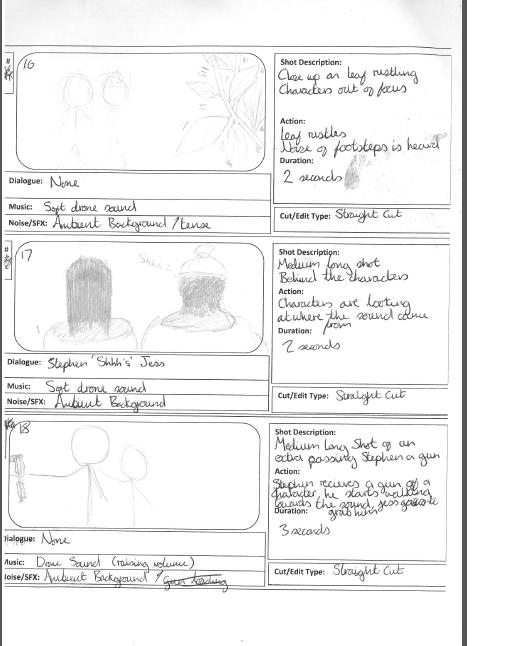
Our storyboard is used as a guideline for when we film our actual product. It is necessary to create storyboards as it will allow us to plan exactly what we want the shot to look like and the editing techniques that are used with it. Details such as shot length, sound and shot type are included so that we know exactly what we're doing before we do it. This document is essential to provide us with clear instruction prior to filming that will save us time and effort.
Wednesday, 20 February 2013
Storyboards
Our storyboard is used as a guideline for when we film our actual product. It is necessary to create storyboards as it will allow us to plan exactly what we want the shot to look like and the editing techniques that are used with it. Details such as shot length, sound and shot type are included so that we know exactly what we're doing before we do it. This document is essential to provide us with clear instruction prior to filming that will save us time and effort.
Monday, 4 February 2013
Shot list
The shot list essentially worked as a sort of check list for our crew. Being as though it contained all the shots that would be included in our segment, it was an important thing to complete and more importantly have with us whilst filming. This list was a hugely useful guide and ensured we didn't forget to film anything and allowed us to shoot the film how it was meant to be filmed.
Friday, 1 February 2013
Location Recce
The location recce was a document required to understand the location of where we were filming and be aware of any problems such as, weather, permissions/access and environmental hazards that could possibly hinder us filming on that day. By doing this, our production process became a lot easier and reliable.
Shooting Schedule
Our shooting schedule is a brief outline of the scenes to be filmed and the cast members involved. Much like the call sheet, the shooting schedule provides the crew with equipment that was required and also when they are expected to be there, along with the cast. This proved useful as it helped us stick to guidelines and ensure we did everything we wanted to according to the schedule.
Tuesday, 13 November 2012
Summaries of research
Jake Hashdi's research summary - Jake has made use of the production companies and their contact departments. He obtained a contact number for Clerkenwell films, the producers of 'Misfits'. He proceeded to call them and inquire about the process of creating a new show. The information is currently pending due to time restraints of the producers, but they have said they will get back to him soon with the relevant information. He planned his questions out in preparation for the call, but was ultimately going to allow the conversation to be open so allow more answers to be obtained and more questions to be developed.
Jake's secondary production research consisted of researching into the producers of 'Top Boy', 'The Inbetweeners' and 'Beaver Falls'. This was done by visiting their respective websites and researching particular conventions they displayed and then discussing how they could be adapted and applied to our own show. This was useful for our group because it allowed us to gather ideas of how to structure our production process and what kind of things we should consider, i.e time management, time slots allocated by broadcasters. The research also added perspective, as it outlined possibilities such as applying our existing film knowledge to the production, as there were many similarities that already existed in the TV production industry.
His secondary audience research involved reading through existing reviews of some drama shows that are influencing ours and noting down what worked well and planning to include it in our show. He found various sites that provide public and critic reviews, to give a more broad understanding of people's opinions. He provided links to top sites like IMDB and newspapers such as The Telegraph, these sites give a strong sense of authenticity to the information because they're cited as very reliable. He included these links, along with a brief summary of the information he found on them in his blog.
Zac Bowen's research summary - Zac has centered a lot of his information around his understanding of youth in his area and capitilised on this by making it a large part of his research. This was essentially a large survey outlining aspects of TV drama that people enjoyed and also their existing knowledge of it. It was based on an old website called 'UK tribes', which collected information from various youth sub-cultures and compared them to develop vast understandings of youth preference. He obtained info from 'Skaters', 'Rockers', 'Townies', 'Sports enthusiasts' and 'Casuals'. These are very varied sub-cultures which means we will obtain very varied and therefore more conclusive research. His conclusion outlines the pros/cons of his respondents responses.
His secondary audience research is a collection of images taken from a textbook 'The Media Student Book'. He used this source due to its reliability and therefore better information. It outlines such features as 'Media representations of audience', 'Media influence' and 'Academic representations of audiences'. This is useful to our group because it will ensure our information is valid and will allow us to edit anything that is wrong.
He repeated this process for his secondary production research. Taking shots from the same book under the section of production. Highlighting such things as 'The production process in outline', 'Finishing, distribution and exhibition'. His conclusion highlights what he can extract from the book and then apply to his own work.
Zac's primary production research involved emailing producers of existing TV drama shows. This research is similar to Jake's phone call. They both ask similar questions, however, they will get a much broader range of results because they're responses from two very different production companies that produce two different drama shows. This results in two perspectives being compared effectively producing better results.
Hannah Walsh's research summary - Hannah began her research with a set of online polls, conducted on http://quizilla.teenick.com and http://www.surveymonkey.com, these questions essentially asked people's opinions of existing drama shows, their age and what they like/disliked. The results she found are very useful because it not only gives us people's opinions, but shows stats such as age/gender, which are useful for seeing who exactly we are appealing to, and more importantly, who E4 are appealing to. Despite the respondents not going into much detail, I can compare my results with Hannah's and draw up comparisons and generalisations that will benefit our group and the production process.
The second part of Hannah's research consisted of finding out which TV dramas were rated the best, in order to find this information, she used sources from the weekly audience figures site 'BARB'. Hannah produced screenshots of her findings. These included numbers and percentages tallied from weekly drama show viewing figures. This is useful for our group because we can see how many people tune in to watch a particular show when it is aired in a particular time period/day. We can decide to air ours in a similar time period.
My own research summary - Firstly, I went about gathering viewer ratings from the site www.imdb.com. I used this site for its reliability and viewer ratings page. The ratings are in the format of bar charts representing how people of different age groups and genders responded to the drama shows I selected. I chose to look at ratings for Misfits, Skins and Dead Set, due to their popularity and influence on our own product. I think these stats will greatly benefit our group because they're adaptable enough to compare with other findings in my group and therefore produce more interesting and clear results.
I then began searching for manuals and tutorials for the equipment we would be using for our own 2 minute clip. To do this, I searched the product on Google and found the most reliable results from the most reliable sites. I searched multiple reviews to find the most accurate review that I could extract from. I found the cameras primary features and added them also. In addition to this, I added large screenshots of the product itself from various different angles to get a good analysis of the product and how it works and where commands are found. Finally, I searched YouTube for a user-friendly video tutorial that catered to people unfamiliar with the product, i.e me and my group, I thought this would be useful because it would not contain a lot of technical terms we were unfamiliar with and instead would slowly introduce us to the camera and build a better understanding.
My final piece of research is into webpages and their typical conventions. I took print screens from the webpage for the drama 'Misfits'. I analysed them and then noted down features I thought worked particularly well and would also work well for my group. I found various features that appealed to younger audiences, but also mature content for that of an older audience, so I tried to make use of this and gather as varied information as I could. The benefit of this will be in the construction of our own site, as we will see a completed product from an already successful production company and use it as a basis for our work.
In addition to this, I had the role of team leader, I therefore made sure everyone had completed their duties accordingly and edited things that we weren't sure of to fit our goals. Before anything was uploaded, it was ran by me and we composed ideas on improvements and things we liked/disliked. This benefited the group as it gave everyone a structure to abide by, which would allow the group to stay focused and get the work done on time. Also, with the technique of a final run through and editing process, it made sure all research was accurate and well presented enough.
Sunday, 11 November 2012
Website research - primary production research
- Heavy use of images relating to episodes and cast members. Used to allow the viewer to recognise characters and navigate the page more easily.
- Character line-up placed in a large image at the top of the page. Used to indicate that they're the main characters and most prominent cast members.
- Each image is accompanied by some sort of tagline followed by a description of the content is leads to/is displaying. This is a great way to improve the page and make it a lot easier to make links and access different features easily.
- Images used to aid the navigation around the page and any additional pages that are connected to the site. Taglines are often links to another section of the site.
- Date underneath the main image states the airing date allowing any viewers that do not know when to tune in, when to turn on the channel.
- Sponsors' in the corner of the image, in this instance LYNX. This relates to mainly young males. A large part of the shows audience.
- Speech bubble on the right side, this allows visitors to leave a comment and broadcast their opinion about the show. A good feature in letting our audience know that they're involved and that their opinions are valued.
- Underneath the comment box, there is comments that have already been posted. This would allow the producers of the show to hear their audiences views and take note of things they like/don't like.
- Sidebar containing links to various sections of the site, such as 'about' 'blog' and a link the 4oD, allowing visitors to watch episodes if they wish.
- A 'like' button linked to Facebook, builds and expands to a larger fanbase which is connected by various different formats. This would be useful for us, as we're young an familiar with such social networking sites and how they work.
- Also a twitter page link. Again expands the shows influence.
- Ability to buy merchandise from the show is underneath the links to the social networking sites. Probably because younger people are more likely to respond due to their association with Facebook and Twitter.
- TV listings tell the viewers when the next episodes will be aired. Suitable for people who do not currently have access to a TV.
- Channel logo (E4) at the top of the page indicates the shows affiliation and what channel it can be viewed on. Also is spray painted which links with the idea of crime. (characters doing community service)
- Basic theme. Relates to how the show is presented. Rough and gritty, also quite dark. Used to add authenticity to the show and website.
- Some sidebars/boxes are in purple and white. The colours of the channel the show is broadcast on.
- Warning to underage viewers underneath the main image. Warning them of strong language and adult content. Therefore showing its audience is predominantly over 18.
Thursday, 8 November 2012
Equipment Research - secondary production research
Key features:
"Thanks to its lineage the D3100 remains one of the most pleasant to hold cameras in its class. It may be small but it's very comfortable to use. It's almost impossible to pick up without your hand falling into a sensible position with the key controls at your fingertips. The layout and positioning of the buttons is some of the best we've come across and their function has on the whole been carefully thought-out too. Our one quibble would be the positioning of the Fn button (which many users, we suspect, will use to control ISO) on the side of the camera, while the the far-less-useful 'info' button occupies prime real estate beside the shutter release." - using this information and applying it to our practical work will benefit me and my group greatly. I believe familarising ourselves with the equipment we're going to be using will allow us to push the boundaries of our capabilities and therefore improve our work. Using screenshots accompanied by a description of the camera itself, allows us to easily locate key functions and understand the layout better. I have also read numerous reviews on the camera and noted its good and bad features. In doing so, I will get a brief idea of the kind of things I should make heavy use of and the kind of things I should avoid. Knowing which works best. In addition, I searched YouTube for video tutorials and demonstrations for the camera. I saved them for further reference and have also embedded them into this post. This will be the perfect referent for when we're in need of answers to a particular problem, as they are catered to the requirements of people completely new to the DSLR's. By viewing the video tutorial and reading multiple guides online I am now fairly familiar with the functions the camera presents and how to successfully navigate through it, accessing different features and setting it up in preparation for what we hope to create.

http://reviews.cnet.co.uk/digital-slrs/nikon-d3100-review-50001105/
http://www.youtube.com/watch?v=ptiTruEXkGk - tutorial part 1
http://www.youtube.com/watch?v=laKpF-el_ak - tutorial part 2
Nikon D3100 Key Features
- 14.2 megapixel DX-format CMOS sensor
- 3.0" LCD monitor (230,000 dots)
- Image sensor cleaning (sensor shake)
- 11 AF points (with 3D tracking)
- IS0 100-3200 range (12,800 expanded)
- HD movies (1080p, 720p or WVGA)
"Thanks to its lineage the D3100 remains one of the most pleasant to hold cameras in its class. It may be small but it's very comfortable to use. It's almost impossible to pick up without your hand falling into a sensible position with the key controls at your fingertips. The layout and positioning of the buttons is some of the best we've come across and their function has on the whole been carefully thought-out too. Our one quibble would be the positioning of the Fn button (which many users, we suspect, will use to control ISO) on the side of the camera, while the the far-less-useful 'info' button occupies prime real estate beside the shutter release." - using this information and applying it to our practical work will benefit me and my group greatly. I believe familarising ourselves with the equipment we're going to be using will allow us to push the boundaries of our capabilities and therefore improve our work. Using screenshots accompanied by a description of the camera itself, allows us to easily locate key functions and understand the layout better. I have also read numerous reviews on the camera and noted its good and bad features. In doing so, I will get a brief idea of the kind of things I should make heavy use of and the kind of things I should avoid. Knowing which works best. In addition, I searched YouTube for video tutorials and demonstrations for the camera. I saved them for further reference and have also embedded them into this post. This will be the perfect referent for when we're in need of answers to a particular problem, as they are catered to the requirements of people completely new to the DSLR's. By viewing the video tutorial and reading multiple guides online I am now fairly familiar with the functions the camera presents and how to successfully navigate through it, accessing different features and setting it up in preparation for what we hope to create.
http://reviews.cnet.co.uk/digital-slrs/nikon-d3100-review-50001105/
http://www.youtube.com/watch?v=ptiTruEXkGk - tutorial part 1
http://www.youtube.com/watch?v=laKpF-el_ak - tutorial part 2
Subscribe to:
Posts (Atom)